

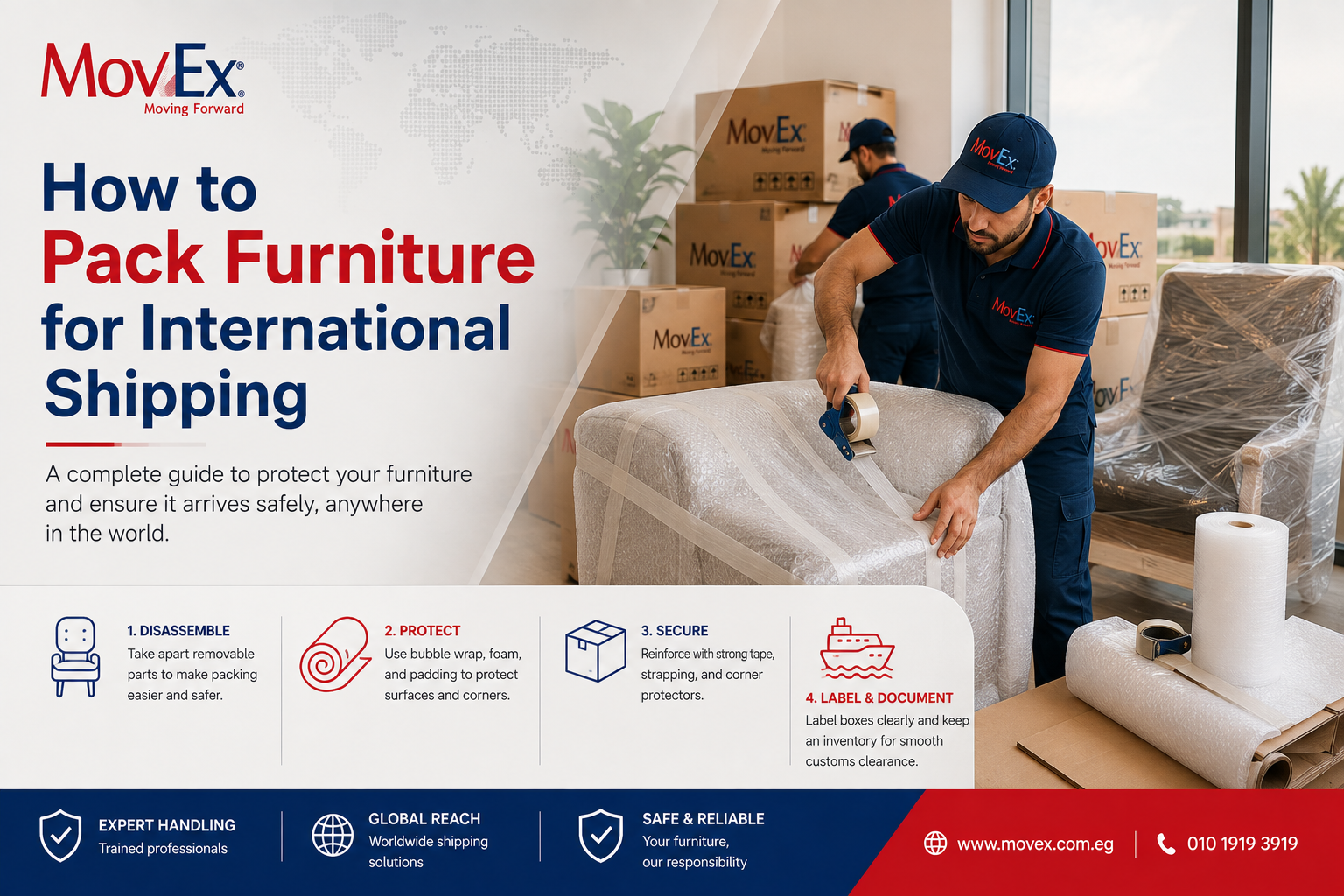
How to Pack Furniture for International Shipping
How to pack furniture for international shipping is the one question that decides whether your move arrives in one piece or turns into an insurance claim. Furniture is the part of an international move people worry about least and damage most — it sits in a container for weeks, gets handled by three or four different crews across two countries, and goes through temperature and humidity swings a local move never sees. Get the packing wrong, and you’re not just risking a scratch. You’re risking a rejected customs inspection, a warped wood panel, or a piece that simply doesn’t fit through the door on the other end.
If you’re shipping furniture out of Egypt — whether it’s a full household move to the Gulf, Europe, or North America, or a single antique cabinet — the packing method matters more than the shipping line you choose. Here’s how it’s actually done.
Start with disassembly, not bubble wrap
Anything that can come apart, should. Bed frames, dining tables, wardrobes, sofas with removable legs — disassembling them isn’t just about saving container space, it’s about removing the weak points. A fully assembled wardrobe flexes during transit and stresses its joints. A disassembled one packs flat, with each panel individually protected.
Keep every screw, bolt, and bracket in a labeled zip bag, taped directly to the matching panel — not thrown into one box “for later.” This is the single most common mistake in DIY international moves: the furniture arrives fine, but half the hardware is missing or unlabeled, and reassembly turns into a two-day guessing game.
Layer the protection — don’t rely on one material
Good furniture packing for international shipping uses three layers, not one:
- A soft inner layer — moving blankets or padded wrap directly on the wood or upholstery, to absorb shock and prevent surface scratches.
- A protective middle layer — bubble wrap or foam sheeting on corners and edges, which take the most impact during loading and unloading.
- A rigid outer layer — corrugated cardboard or, for higher-value pieces, custom wooden crating. Crating matters more than people expect for international shipments specifically, because furniture gets restacked and cross-loaded multiple times between the origin port and destination address.
Wrap wood surfaces in plastic film before the moving blanket goes on — humidity inside a shipping container during a 3-4 week sea transit can cause uncovered wood to swell or the finish to sweat, especially on routes through the Gulf or Southeast Asia.
Wooden crating for high-value or antique pieces
For anything with real value — antique furniture, marble-top tables, glass cabinets, pieces with inlay or veneer — standard wrapping isn’t enough. Custom wooden crates, built to the exact dimensions of the piece with internal foam bracing, are the standard for a reason: they distribute weight properly during stacking and protect against the compression forces that happen when a container is fully loaded. This is exactly the kind of job that belongs with a team that handles fine arts and antiques shipping specifically, since insurance underwriters often require crating documentation for high-value claims anyway.
Label everything by room and by handling instruction, not just a number
International moves go through customs inspection, and inspectors move faster — and are less likely to open a box unnecessarily — when labeling is clear. Label each piece or box with the destination room, a general contents description, and any handling instruction (“FRAGILE,” “THIS SIDE UP,” “GLASS — DO NOT STACK”). Keep a numbered master inventory list matching every label, because you’ll need it for both the customs declaration and the insurance valuation if anything needs to be claimed later.
Don’t skip the packing list and photos
Before anything goes into the container, photograph every piece of furniture from multiple angles, especially existing scratches or wear. This isn’t paranoia — it’s what protects you if a damage claim comes down to “was this scratch already there.” Keep a written inventory with approximate values; most international movers, including MovEx, will ask for this to arrange proper transit insurance.
Where professional packing actually pays for itself
DIY packing can work for a few boxes. For a full household of furniture going overseas, the math usually favors professional packing once you account for crate materials, the time involved, and the risk of a damaged piece that costs more to replace than the packing service would have cost in the first place. MovEx’s packing and packaging service uses export-grade materials and trained crews specifically for international shipments, and ties directly into MovEx’s international moving service — so the same team that packs your furniture also handles customs documentation and delivery at destination, rather than handing off between separate companies.
Planning an international move and want your furniture packed to survive a 4-6 week transit without a scratch?